
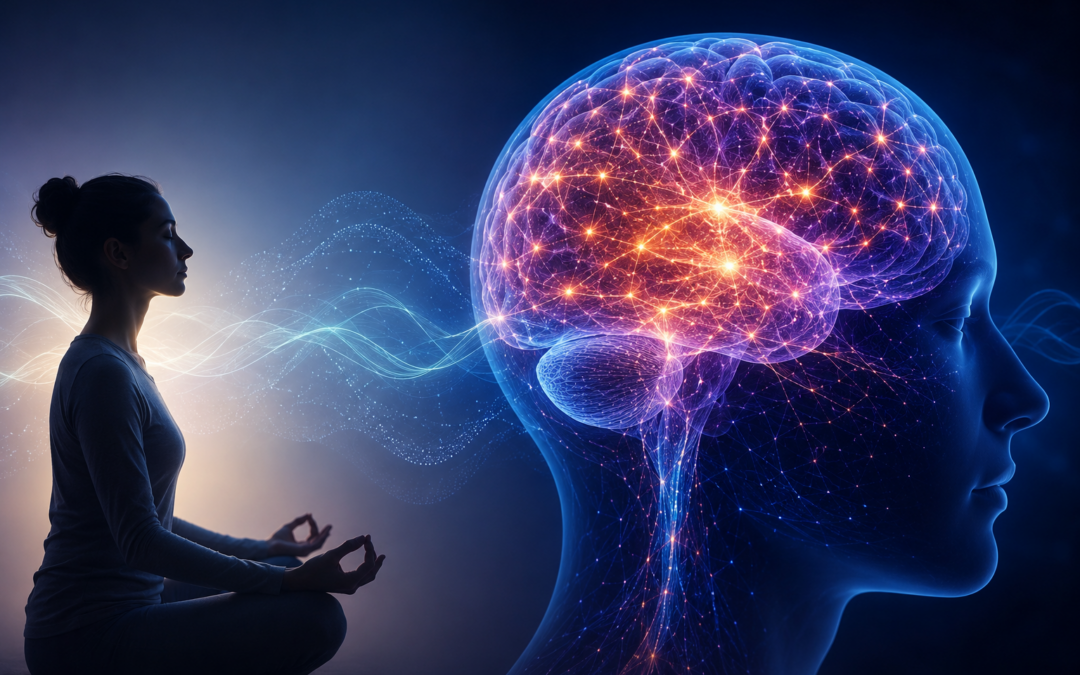
A fascinating point of convergence with Osho’s vision: the idea that meditation is not merely a mystical practice, but something that can be explored through observation, experience, and scientific research.
The meditative state produces measurable changes in the functional organization of the human brain. Rather than activating a single “meditation center,” meditation appears to modify the way different brain networks communicate with one another, regulate attention, process emotions, and construct the sense of self.
One of the most studied effects concerns the Default Mode Network (DMN), a network involving, among other regions, the medial prefrontal cortex and the posterior cingulate cortex. This network is normally active when the mind wanders, when we reflect on ourselves, recall the past, imagine the future, and maintain our narrative sense of “self.” During meditation, particularly in mindfulness or open-awareness practices, DMN activity often decreases, and identification with spontaneous thoughts becomes less prominent. This may correspond to the experience of a calmer mind and a greater ability to observe thoughts without being carried away by them.
At the same time, meditation strengthens the interaction between networks involved in attention and executive regulation, particularly the prefrontal cortex and the anterior cingulate cortex. These systems are responsible for sustained attention, self-regulation, and the ability to return to the present moment when the mind wanders. With regular practice, meditators often demonstrate greater attentional stability and increased cognitive flexibility.
Meditation also influences the salience network, which helps the brain determine what is important and where to direct attention. Practices involving compassion, acceptance, or non-judgment can alter the way the brain responds to emotional stimuli, allowing experiences to be perceived with fewer automatic reactions.
Another important effect concerns the relationship between the amygdala (involved in threat detection and emotional responses) and regulatory regions of the prefrontal cortex. Regular meditation practice is associated with reduced emotional reactivity and a greater ability to remain present in the face of difficult sensations or emotions without immediately reacting to them.
At the level of brain connectivity, meditation appears to promote a state of greater integration: different brain networks communicate in a more harmonious way, while habitual and unnecessary patterns of activation become less dominant. In this sense, meditation does not simply “relax” the brain; it may reorganize the relationship between consciousness, attention, emotions, and self-perception.
From a neuroscientific perspective, meditation can therefore be described as a form of consciousness training that modifies the brain’s functional dynamics. From a contemplative perspective, this corresponds to a transition from a state in which one is unconsciously driven by thoughts, memories, and conditioning toward a state of greater presence, awareness, and freedom.
In summary:
Meditation reduces the dominance of self-referential mental activity, strengthens networks involved in attention and emotional regulation, increases functional integration between brain systems, and promotes a more flexible and conscious way of experiencing reality.

Chinta B. Strubin
e-mail